Management System
Across 2 fabric and 2 accessory warehouses at Snowtex Group's woven facility, inventory management was entirely paper-driven. Bin cards were updated by hand on every roll movement. GRNs were raised on paper and entered into records after significant delay. With roughly 3,000 fabric rolls received and 3,000 issued to cutting every day, the manual system accumulated errors faster than staff could correct them. Mismatched figures were routine. Wrong rolls went to cutting. Rolls disappeared for extended periods. Locating a specific roll meant a physical search across thousands of bin positions on every shift.
The project mandate was to digitize the full inventory lifecycle: attach a unique identity to every roll at receipt, track its location in real time, automate GRN generation at the point of issue, and eliminate the paper infrastructure entirely.
| KPI | Before System | Root Cause |
|---|---|---|
| Inventory Accuracy | 75% | Manual bin card errors, missing roll records, delayed reconciliation |
| Fabric Issue Time | ~30 min per GRN | Manual roll search by description, paper GRN preparation, supervisor sign-off chain |
| Daily GRN Volume | ~300 GRNs/day | Processing bottleneck limited capacity; backlog on high-throughput days |
| Annual Bin Card Usage | ~6,000 bin cards/year | One card per roll per bin movement, all written, filed, and stored manually |
| Cutting Floor Reception Staff | 11 dedicated personnel | One staff per floor (11 floors) manually verifying and reconciling incoming rolls, identified through BA process mapping |
- Eliminate manual bin card processes through digital roll-level QR tracking
- Automate GRN generation at the point of issue via QR scan, removing manual paperwork from the issuing workflow
- Achieve real-time inventory visibility across all 4 warehouses
- Eliminate inventory mismatches through scan-verified issue and receipt processes
- Improve fabric roll traceability from receipt through to cutting floor delivery
- Reduce operational errors caused by wrong fabric issuance
- Integrate with ERP to ensure GRNs and inventory data reflect in records without manual entry
Requirements came from GEMBA walks, floor observations, stakeholder workshops, and direct meetings with warehouse management, cutting floor supervisors, and IT. The GEMBA walks were deliberate: warehouse management described the process one way in meetings; the floor showed a different operational reality. Dead stock accumulation, the scale of bin card inaccuracy, and the workflow tying 11 staff to manual GRN reception only became visible through direct observation.
- Process mapping revealed 11 fabric receiving staff, one per floor, each manually verifying, recording, and reconciling incoming rolls. The role existed entirely because the warehouse had no reliable way to pre-confirm what was being issued. Eliminated by the QR issuing workflow.
- GRN generation took approximately 30 minutes per GRN at the cutting floor, creating a throughput ceiling that produced backlogs on high-volume days.
- Issue delay was partly caused by time spent searching for specific rolls by description, no bin address system existed.
- GEMBA walks identified poor dead stock management: rolls in-house for extended periods without being flagged, located, or allocated, invisible to management because bin cards were the only tracking mechanism.
- Bin card inaccuracy was structural, not behavioural: the daily roll volume made manual card updates impossible to sustain without error at scale.
- Stock mismatches between physical inventory and records were chronic, the gap between what records showed and what existed on the floor was the single largest operational risk in the warehouse.
Key elicitation insight: Network connectivity in the warehouse was not identified as a constraint during the requirements phase, it surfaced only after implementation began. A subsequent GEMBA during implementation confirmed the coverage gaps. IT resolved the issue by deploying additional routers across the store. This delayed the implementation timeline and was logged as a risk for future warehouse digitization projects.
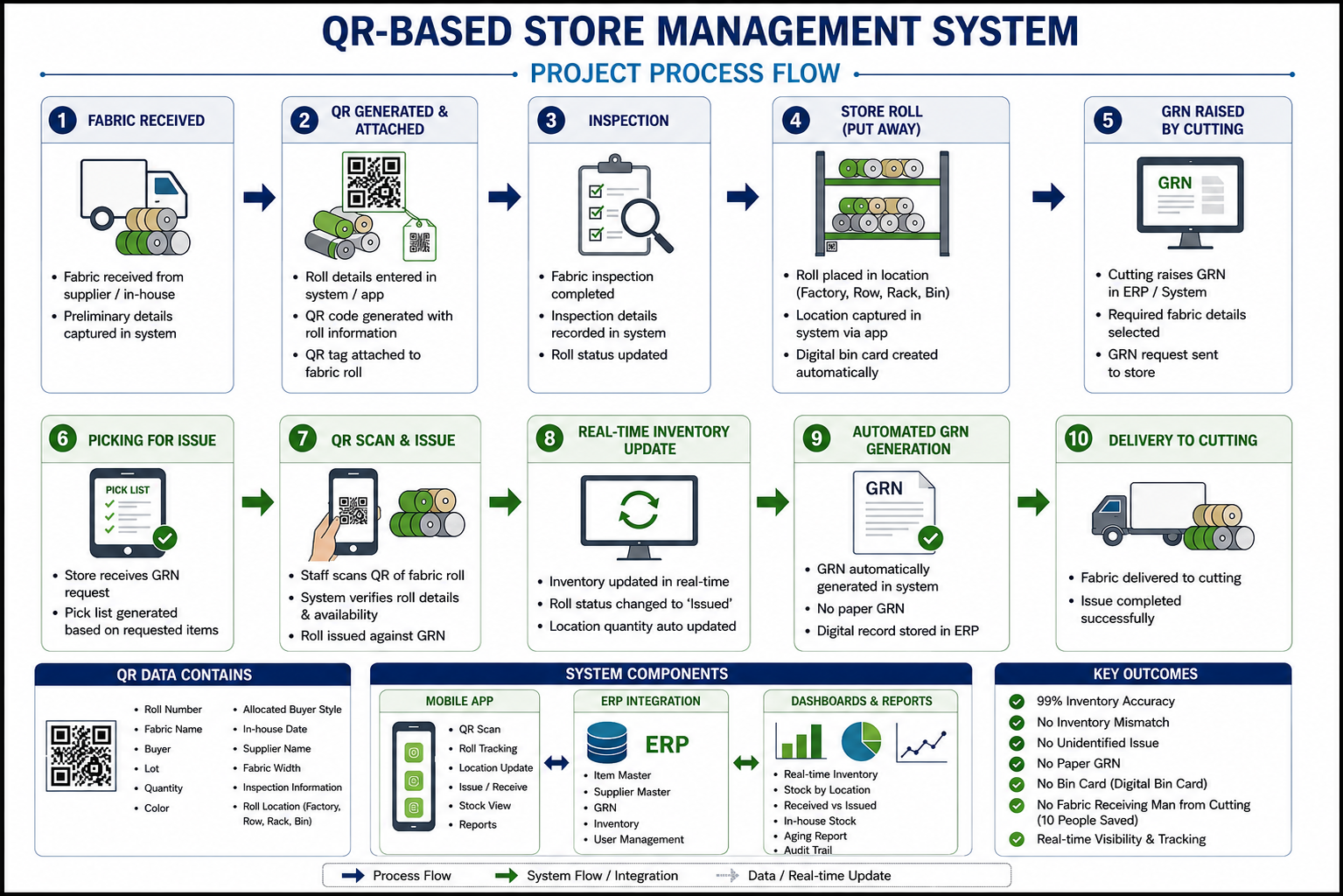
The QR data structure and report structure were designed from scratch, not inherited from an existing system or specified by IT. Each field was determined through requirements sessions with warehouse management, cutting supervisors, and QA. Every field included was required by a specific operational workflow at the point of scan. The structure was iterated in workshops and handed to developers as a formal build specification.
Location was tracked as a four-level hierarchy. When a roll went into a bin, the operative scanned the roll QR then the bin QR in a single phone operation. The system linked the two and recorded the placement automatically. No manual entry, no handwriting, no lookup.
| Component | Description | BA Contribution |
|---|---|---|
| Custom QR Generator | In-house tool generating roll-specific QR labels at point of receipt. Encodes full roll identity and prints on demand. | Data structure (11 fields) designed and specified by the implementation team |
| Custom Mobile Application | Purpose-built for warehouse operatives. Handles dual-scan bin placement, inspection logging, and roll search via phone. | Workflow and UX requirements specified by the implementation team; handed to developers as build spec |
| Fixed Issue Terminals | Dedicated scan stations at cutting floor issue points for high-volume, controlled GRN generation. | Terminal placement and scan workflow defined by the implementation team through floor observation |
| Digital Bin Card System | Replaces ~6,000 annual paper bin cards with auto-updated digital records. Full movement history per QR. | Digital bin card structure and update logic specified by the implementation team |
| ERP Integration | GRN data and inventory updates flow to ERP automatically on scan. Eliminates separate manual ERP data entry. | Integration requirements and data mapping specified by the implementation team |
| Dashboard & Reports | Live inventory visibility for management, roll location, stock levels, issuance status in real time. | Report structure and dashboard layout designed by the implementation team before developer build |
BA Deliverables. Designed from scratch by the implementation team: the QR data structure (11 fields); the report and dashboard structure; the process flows for the cutting section and fabric store (produced through GEMBA); the 4-level bin location hierarchy; the dual-scan placement workflow; and the technology requirements handed to developers as formal specifications.
Three challenges emerged during the project: a stakeholder technology disagreement before implementation started, an adoption and stability crisis during early deployment, and a recurring operational risk that appeared after go-live. All three needed structural responses, not just communication.
Challenge: The warehouse management team was disengaged from the proposed QR system and advocated for RFID auto-scanning. Their position was not unreasonable. RFID removes the need for manual scan actions and is perceived as higher-capability technology. However, RFID at the required scale (4 warehouses, ~3,000 daily roll movements, full bin-level tracking) would have required significantly higher capital investment in tags, fixed readers, and infrastructure, a cost the project budget could not absorb. A disengaged management team preferring a different technology was a direct risk to adoption and implementation support.
BA Action: Rather than dismissing the RFID preference or escalating to override it, the BA prepared a structured cost comparison: QR sticker unit cost versus RFID tag unit cost, combined with the additional infrastructure cost of RFID scanning stations across the warehouse network. The comparison was presented directly to warehouse management, alongside a demonstration that QR delivered equivalent operational output for this use case. The case was made on numbers, not persuasion.
Challenge: Warehouse operatives resisted adopting the system in the early weeks of deployment. A surface reading pointed to change resistance. The BA's diagnosis, confirmed through GEMBA observation during implementation, was different: resistance was rooted in system instability, not change aversion. The in-house application had bugs causing real workflow failures for staff managing thousands of roll movements per day. An unreliable system is operationally worse than the manual process it replaces. The root cause was structural: no developers were formally dedicated to the project, so bugs accumulated faster than the shared-resource model could resolve them.
BA Action: The BA identified that the correct intervention was reliability improvement, not change management or more training. This led to a formal escalation to management framed as a delivery risk: the shared-resource development model could not produce a stable system within the required timeline. Following the escalation, 2 developers were formally dedicated to the project. A bug triage protocol was established simultaneously, and fix timelines were communicated directly to warehouse supervisors so staff could see reported issues being actioned.
Challenge: QR labels on fabric rolls were subject to physical damage in active warehouse conditions, tearing during handling, smearing from moisture, and degradation on rolls stored for extended periods. A damaged QR cannot be scanned, breaking the tracking chain: a roll without a readable QR is effectively invisible to the system, replicating the untracked inventory the project was designed to eliminate. This risk materialized, damaged labels were observed during normal operations, particularly on high-movement rolls and in high-humidity storage zones.
BA and Operational Action: A reprint protocol was established as a standing operational procedure. Warehouse supervisors were authorized to flag and request label reprints for any roll with a damaged QR, with the reprint carrying the original roll identity from the system record. Staff were briefed to treat label integrity as part of roll management. Label placement guidance was updated to position QR labels on the more protected inner-facing surface of roll wrapping where feasible.
All three challenges shared a common structure: a legitimate operational problem that could not be solved through instruction alone. Each required a structural response, a cost comparison, a resource escalation, or a standing protocol. The BA's role in each case was to correctly diagnose the structural gap and drive the change that closed it.
| Objective | Delivered | Measured Impact | Status |
|---|---|---|---|
| Increase inventory accuracy | QR scan-verified receipt, placement, and issue, every movement tracked at roll level | Accuracy: 75% → 99% | ACHIEVED |
| Eliminate inventory mismatches | Scan-at-issue workflow prevents wrong roll issuance; system rejects mismatched requests | Inventory mismatch: Eliminated | ACHIEVED |
| Remove manual paperwork | Paper GRN replaced by automated generation at scan; bin cards replaced by digital records | Paper GRN: Eliminated · Bin cards: Digital | ACHIEVED |
| Improve roll traceability | Full movement history per QR, from receipt through bin placement to cutting floor issue | Unidentified fabric issues: Eliminated | ACHIEVED |
| Reduce operational errors | System-enforced issue matching and scan verification replaced judgment-based manual processes | Wrong fabric issuance: Eliminated | ACHIEVED |
| Real-time inventory visibility | Live dashboard reflects every scan, no end-of-shift reconciliation required | Management visibility: Real-time | ACHIEVED |
| Streamline issuing process | Fixed terminal scan-and-issue workflow; cutting floor reception staff requirement removed | GRN time: 30 min → ~5 min · 11 reception staff: Eliminated | ACHIEVED |
| Metric | Before | After |
|---|---|---|
| Inventory Accuracy | 75% — chronic mismatches | 99% at 6 months |
| Inventory Mismatch | Existing · routine occurrence | Eliminated |
| GRN Time | ~30 minutes per GRN | ~5 minutes · 83% reduction |
| Paper GRN | Manual · paper-based | Automated at point of scan |
| Bin Cards | Manual · ~6,000/year | Digital · auto-updated |
| Unidentified Fabric | Existing · missing roll events | Eliminated |
| Cutting Reception Staff | 11 dedicated personnel | Role eliminated by scan workflow |
Gap 01 — QR label durability is managed through the reprint protocol (see §5 Risk Register) and remains an ongoing operational item. Physical label damage in warehouse conditions cannot be eliminated entirely. The reprint protocol addresses individual incidents but does not prevent them. A future improvement would be to evaluate more durable label materials (laminated or industrial-grade adhesives) for rolls in long-term storage or high-humidity bin zones. This is an operational specification improvement, not a system design flaw.
Gap 02 — ERP integration scope may require expansion as accessory warehouse workflows mature. The current ERP integration was specified against fabric roll workflows. Accessory warehouse issuing patterns are structurally different (smaller quantities, higher item variety) and may surface edge cases not covered in the initial integration specification. A review of accessory-specific GRN logic is recommended at the 12-month mark.
| Risk | Category | Likelihood · Impact | Mitigation | Outcome |
|---|---|---|---|---|
| Warehouse management disengagement due to RFID preference | Stakeholder | High · High | Structured cost comparison prepared and presented; QR equivalence demonstrated on operational grounds | MATERIALIZED · RESOLVED — Management accepted QR approach after cost comparison. Engagement recovered. |
| Staff non-adoption due to system instability from insufficient development resource | People · Technical | High · Critical | Formal escalation secured 2 dedicated developers; bug triage protocol established; fix timelines communicated directly to supervisors | MATERIALIZED · RESOLVED — Resistance observed early. Resolved through system stabilisation after dedicated developer assignment. |
| Warehouse network connectivity insufficient for mobile app | Technical · Infrastructure | Medium · High | Not identified pre-implementation, surfaced through GEMBA walks during deployment; IT engaged and resolved | MATERIALIZED · RESOLVED — IT deployed additional routers. Delayed implementation timeline. Demonstrates value of continuing GEMBA beyond requirements phase. |
| QR label damage disrupting roll tracking chain | Operational | Medium · High | Reprint protocol established as standing procedure; label placement guidance updated; supervisor authorization for reprints | MATERIALIZED · MANAGED — Damage observed in live operations. Managed through reprint protocol. No systemic untracked inventory event post-protocol. |
| Cutting floor scan throughput insufficient for ~3,000 daily issue volume | Technical · Capacity | Medium · High | Fixed terminals deployed at defined issue stations; count sized against peak volume estimate; tested during pilot | MITIGATED — Fixed terminal deployment absorbed peak daily scan volume. No throughput bottleneck observed at full scale. |